
Dear beautiful adventurers, if you’re planning to fly to Seoul soon and considering getting double eyelid surgery, a nose job, or Thermage treatments, please pause your finger on the flight app for a moment. I have some bad news: the tax rebate policy that made medical treatments in Korea so affordable is about to end.
That’s right—the “foreigner VAT rebate” program that drove countless Asian women crazy and kept plastic surgery clinics in Seoul’s Gangnam district bustling. According to South Korea’s latest tax reform plan for 2025, this benefit, which had been in place for nearly a decade, will come to an end on December 31, 2025.
What does this mean? Simply put, starting from January 1, 2026, whether you get photon rejuvenation treatments worth tens of thousands of Korean won or cosmetic surgeries costing millions, you will no longer be able to get a 10% cash rebate on your expenses.
In today’s article, we’ll avoid the technical jargon and talk about it in plain terms: how this policy helped us save money in the past, why the South Korean government decided to end it, and whether we should still consider going to Korea for beauty treatments in 2026 without this rebate.
First, let’s understand how that 10% rebate worked. How did we manage to save so much money?
Over the past few years, getting medical treatments in Korea was practically like a vacation where you could save money while having fun.
Here were the rules: as long as you held a foreign passport and spent money at designated “medical tax rebate partner institutions” in Korea, and your purchase amount exceeded a certain threshold (usually around 30,000 Korean won, or about 150 yuan), you could get a 10% VAT rebate when leaving the country, either at the airport customs counter or through the rebate system used by the clinic.
Don’t underestimate that
10%. For example, if you got a comprehensive eye surgery costing 5 million Korean won (about 26,000 yuan), you used to get back 500,000 Korean won in cash. That amount was enough to treat yourself to several top-quality Korean beef meals in Myeongdong or buy lots of face masks to give to your friends.
For many budget-conscious consumers, that 10% rebate was the deciding factor between getting treatments in Korea or locally. It gave Korean medical services a significant competitive advantage, making them even more attractive than those in other Southeast Asian countries.
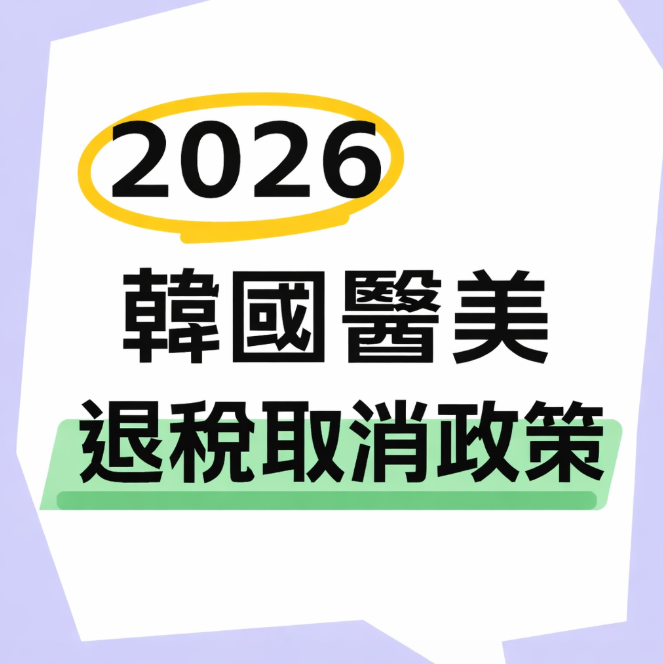
Second, why did the South Korean government decide to end this tax rebate policy? What are their reasons?
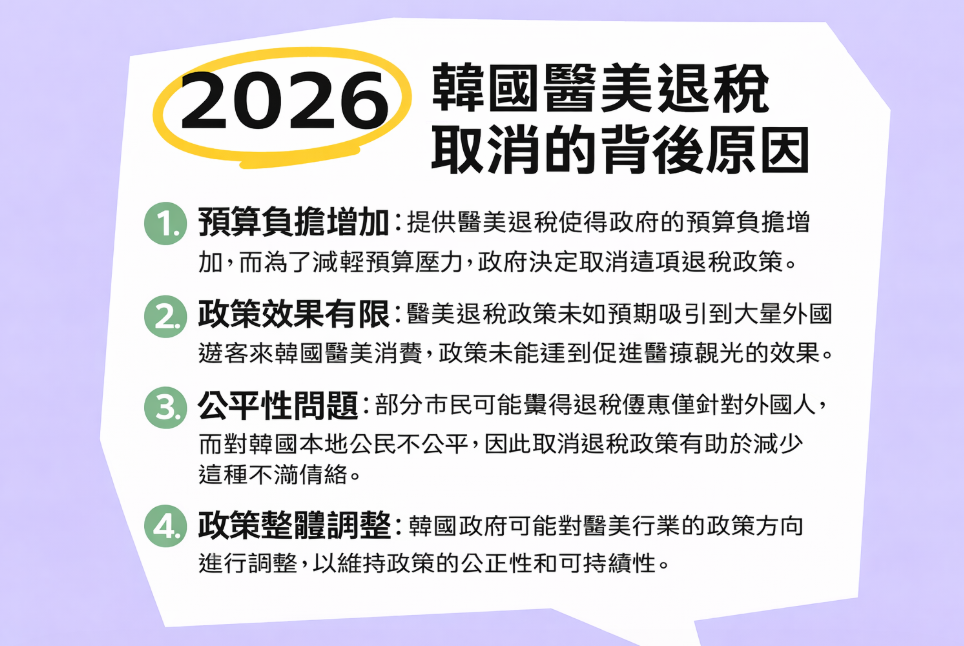
Since this policy was so popular, why did the South Korean government decide to end it? Could it be that they overreached? In fact, there are several practical reasons behind this decision.
1. The “pilot program” has concluded successfully. This
policy was first introduced in April 2016 under the name “temporary special exemption.” It was originally designed as a temporary measure to boost the medical tourism industry and was intended to last for one year. However, its success led to a significant increase in foreign tourists, so the program was extended year after year until it ended in late 2025. Now, the South Korean government believes that the internatio
nal reputation of Korean cosmetic surgery is strong enough, and there is no need to rely on discounts anymore. Data shows that in 2024, the number of foreign tourists seeking cosmetic treatments in South Korea exceeded 1.17 million, indicating that the industry has grown sufficiently large for the government to phase out this incentive.
2. Fiscal pressures and fairness concerns: Tax refun
ds essentially mean that the government earns less revenue. Every year, these refunds result in billions of won less in tax revenues for the South Korean treasury. Given the current uncertain global economic situation, the government needs to find way
s to reduce expenses. Additionally, there have been objections domestically regarding the unfairness of allowing foreigners to receive tax refunds while local residents have to pay full prices. Although local residents can still get tax deductions through other medical expenses, this perceived disparity continues to generate debate.
3. The ambition for industrial upgrading
: South Korea seems to want to shift from a “price war” to a “value war.” They aim to attract higher-end customers who value technology and service quality, rather than those solely interested in tax savings. Ending the tax refund policy may serve as a means to filter customers and encourage institutions to improve their technical standards rather than rely on price advantages.
III. Is it still worth going to South Korea for cosmetic surgery after 2026?
This is the question that everyone is most concerned about. Without the 10% tax refund, is South Korea still a viable option for cosmetic surgery?
The answer depends on the specific procedure and individual needs, but the era of impulsive decisions without careful consideration is over.
- For high-value surgeries such as contouring, rhinoplasty, or breast augmentatio
n, the impact is relatively minor. South Korea remains at the forefront globally in these areas, with advanced techniques, experienced doctors, and a high level of aesthetic standards. Even without the 10% discount, the cost-performance ratio is still competitive compared to European, American, and some domestic premium institutions. What you are paying for is their expertise and safety, not just the tax savings. - For minor cosmetic procedures like injections, lasers, or skin treatments,
the impact will be greater. However, the enthusiasm for traveling to South Korea for these services remains strong, given the high-quality care provided by local doctors. It’s a great opportunity to combine a vacation with some skincare treatments—so why not? - Hidden costs increase: In addit
ion to the loss of tax refunds, the rising popularity of tourism in South Korea has also led to higher airfare and accommodation prices. Previously, the tax refund could cover part of the costs associated with travel, but now consumers have to foot the extra expenses themselves.

IV. Some sincere suggestions for those who want to improve their appearance in Korea
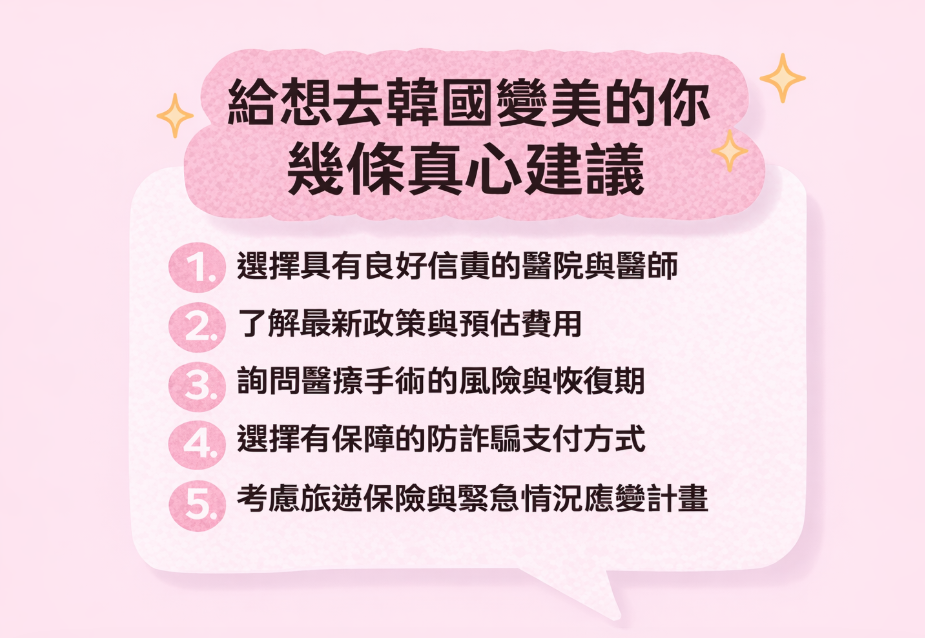
Since the policy has been established, complaining is of no use. If you plan to travel to Korea in 2026 or later, here are some practical suggestions:
- It’s still important to choose a “designated institut
ion”: Although tax refunds are no longer possible, it’s still recommended to opt for clinics that were previously “tax-refund eligible”. Why? Because those on this list are usually more reputable and subject to stricter government regulation, so the risks of scams or medical accidents are relatively lower. Don’t just pick any random clinic in a back alley just because tax refunds aren’t available. - There’s more room for negotiation when
it comes to prices: In the past, clinics would say, “Since you can get a tax refund anyway, we won’t offer discounts.” Now that tax refunds are gone, you have leverage to negotiate. You can directly ask the consultant, “Since there’s no tax refund now, can you give me some discount on the original price?” or request additional post-treatment services for free. - Beware of “tax-refund scam” schemes: After
the policy change, some unscrupulous intermediaries or clinics might claim, “We have internal channels that can still help you get a tax refund.” Don’t believe them! This is definitely a scam. The customs system has been updated, and consumption records from after 2026 cannot be used to apply for tax refunds through official channels. Not only will you not get your money back, but you may also expose your personal information and even risk getting involved in money laundering activities. - Do your homework and find a reputable doctor:
Since the price advantage has diminished, it’s even more important to focus on technical expertise. Don’t just rely on advertisements; research the doctor’s qualifications, look at real case studies (be careful to distinguish between genuine and fake images), and even consider having a video consultation first. Spending money on a doctor who truly suits you is far more valuable than saving a little money.
Say goodbye to unfair practices and embrace rational approaches to beauty
The end of Korea’s tax-refund policy for cosmetic procedures marks the end of an era. Those days when you could get a 10% discount just by flying there are now completely thing of the past.
But this isn’t necessarily a bad thing. It forces us as consumers to shift our focus from simply looking at prices to paying attention to medical quality, safety services, and the overall experience. Investing in your appearance is a lifelong decision; you shouldn’t take risks just to save a little on airfare.
If you still choose Korea in 2026, it should be because you recognize the quality of its medical services and appreciate its aesthetic standards, not because of an expired “discount coupon”.
One last reminder: The policy officially took effect on January 1, 2026. If you are still hesitating, or if you hear someone say that it’s still possible to cancel now, please be very careful to avoid wasting your time and feeling disappointed.
Wishing everyone who strives for beauty to achieve their ideal self through rational decision-making. Goodbye to tax refunds for cosmetic procedures; hello to a brand-new journey towards beauty.
If you are interested in learning more about or booking a Korean dermatology clinic, you can consult or make an appointment in the following ways: